BUSINESS e-weights

When packing under the minimum weight system, the most underfilled punnet is still above the weight printed on the label.
℮-WEIGHTS
This article summarises a presentation given by Julian Horsley at BerryQuest International 2025. Watch the recording at bit.ly/BQI25-e-weights
Words Helen Newman, WA Berry Industry Development Officer, Agricultural Produce Commission
• The Average Quantity System (AQS) or e-weights, allows punnets to be filled with an average amount across a batch, rather than having to ensure every single punnet meets a minimum weight target
• Permitted in Australia since 2010, e-weights allow growers to reduce overpack (giveaways) and improve efficiency and profitability
VEGEMITE is a registered trademark of Bega Cheese Limited
e-weights compared to minimum weights

EVERY packing process (manual or automated) has +/-variations. When using e-weights, it’s all about the ‘batch’, not the ‘individual punnet’.
When packing under the minimum weight system, the most underfilled punnet is still above the weight printed on the label. In the example shown in Figure 1, if the punnet says 500g, it may contain anything from 501 to 511g, with an average punnet weight of 506g.
When packing under the AQS (e-weight) system, the most underfilled punnet may be less than the weight printed on the label, but the average of the batch going to the customer is above the stated weight printed on the label.
The average punnet weight in the e-weight example is 501g, 5 grams less than the average punnet weight of the minimum weight example. This saving quickly adds up over a season!
FIGURE 1. Example of how weight variations are managed under AQS (e-weights) (left) compared to the traditional minimum weight system (right).

* UTML: Upper Tolerable Minus Limit is the largest permitted shortfall from the declared net weight before a package is considered underweight
e-weight measurement rules
1. The average amount in a batch or consignment must be equal to or greater than the amount stated on the label. This is called the ‘nominal quantity’.
2. A small number of punnets can have slightly less than the labelled amount, but not more than a certain limit. This is called the ‘tolerable deficiency’.
3. No punnet can have less than twice the prescribed tolerable deficiency.
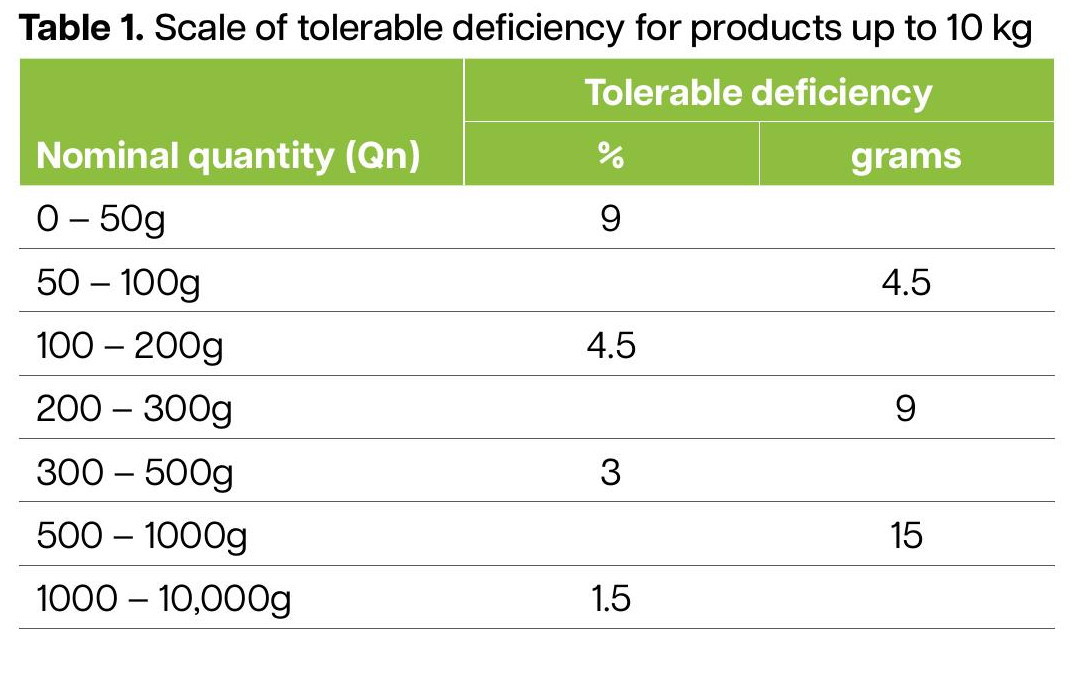
The National Measurement Institute (NMI) has set a scale of tolerable deficiency according to nominal quantity. According to this scale, if the nominal quantity of a punnet is 250g, the tolerable deficiency is 9g; if the nominal quantity is 500g the tolerable deficiency is 3% or 15g (Table 1). Figure 2 shows a simplified example of how this looks for a 500g punnet.
What defines a ‘batch’?
The size of a batch is not determined by the NMI; it is defined by you as a business. It could be the size of a sales order, or a job lot. The aim with AQS (e-weights) is to monitor the statistics as each product is weighed, adjusting as you go, so at the end of your batch you end up as close to the set average as possible. This is how you achieve the best possible yield from your product and the lowest level of giveaway.
Keys to success and compliance
• Discuss with your customers when you plan to implement e-weights. If it’s your own brand it’s ultimately up to you, but if the brand is owned by others, you will need their approval.
• Implement the ‘e’ symbol on your packaging. Visit bit.ly/ABJ-NMI for more information and to download the ‘e’ symbol.
• Make sure your inline weighing systems can run the Average Quantity System (e-weights).
• Ensure robust record keeping & data capture — this is important in managing complaints and compliance.
• Educate your staff and stakeholders so they are aware and understand e-weights.
• Prepare for customer complaints and education on e-weights.

FIGURE 2. Simplified summary of the AQS (e-weight) method showing how the three measurement rules are applied for a 500g punnet. Rejected punnets <Qn NG and T1 NG may be added to a batch later in the packing process when the statistics support them (when the average weight is higher than the nominal weight and the quantity of T1 items is below 2.5%) or be re-worked.

Be prepared for complaints
When using e-weights you are allowed to have a certain number of underweight packs. That doesn’t mean that the consumer is going to be happy when they buy it. It just means their next-door neighbour might have got their extra bean!
Steps for migrating to AQS (e-weights) packaging in Australia
Understanding the regulations
Familiarise yourself with the specific AQS regulations set by the National Measurement Institute. You can find all the details at bit.ly/ABJ-NMI
Equipment and process review
Evaluate your current packaging equipment and processes. AQS requires accurate filling and reliable measurement systems. You might need to invest in upgrades or new equipment to ensure consistent average weight across packages.
Sampling and testing procedures
Develop a sampling and testing plan to monitor your AQS compliance. This involves regularly taking samples of filled packages and statistically analysing the average weight against the declared amount. The most efficient way to do this is to get an AQS compatible inline checkweigher.
Labelling updates
Update your packaging labels to reflect the AQS system. Labels should clearly state the average amount of the product, following the NMI guidelines. This involves adding the ‘e’ (‘estimated’) symbol next to the net weight value.
Record keeping
Use checkweigher systems to monitor the average net content of all packs inspected. Maintain detailed records of your AQS compliance checks and sampling data. This demonstrates your adherence to regulations during potential audits by NMI inspectors. Most modern inline checkweighers can collect and report on 100% of your weight data and create the required batch reports.
Average Quantity System
The Average Quantity System (AQS) works in compliance with the National Measurement Institute’s (NMI) Weights and Measures program to ensure accuracy in pre-packaged goods. AQS is designed to be fair for both consumers and manufacturers.
Detailed guidance on how to use this system is available on the NMI website at bit.ly/ABJ-NMI
Educate your staff and stakeholders so they are aware and understand e-weights.
MORE INFORMATION
You can find out more about the equipment available from A&D Weighing to assist you with AQS implementation at www.andweighing.com.au
Acknowledgment
Berries Australia thanks Julian Horsley from A&D Weighing for his assistance on this topic.